Monday, January 26, 2015

Karen New Year

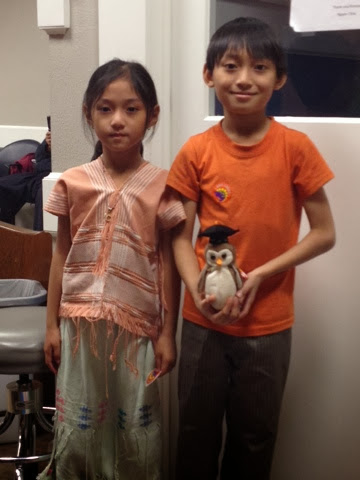
The annual celebration of the Karen New Year was held on Saturday evening at Highland Oaks Baptist Church, just across the street from Newport apartments in Garland, where a huge community of Karen now live.


The 3 hour celebration was complete with dancing and singing by Karen youth groups from all over Texas, wonderful traditional food, and a presentation of the Karen tribe's history dating back to ancient Babylonia.


Having been involved in the Karen community for the past years, Aaron and I both noted how far they've come in such a short time here in America.  This celebration provided an opportunity to appreciate the rich cultural heritage of this resilient ethnic community, who has overcome so many obstacles and continues to persevere.  We continue to be honored to work with this incredible group of individuals in our community.

Wednesday, October 1, 2014

Flu Shots!

When word gets out in the refugee community that our flu shots are in, we have to brace ourselves for the deluge of families who come into clinic. I'm not sure if they are so pro-vaccine because of the time they spent in the refugee camps or what, but the refugees we serve LOVE them some flu shots! Despite the hectic pace of clinic the past couple of Sundays, we still managed to fit in some time for fun. Here's a photo of me, Daw Li and Sur Gay Moo modeling some of the wigs that were recently donated to the clinic! :)

Wednesday, September 10, 2014

Happy Fall!

I apologize for the silence on the blog over the summer...our Sunday refugee clinic has been plugging away and continues to serve between 10 and 25 patients each Sunday afternoon.  We've seen an upswing in the number of refugees who come to the clinic solely for what we have termed "case management."  Rather than needing medical help, these individuals and their families come to the clinic for help managing and understanding bills they've received from hospital stays, dealing with problems with employers, medical and auto insurers, and apartment managers.  The Karen refugees that come to clinic are vulnerable and are often victims of scams.  As an example, one family came in for assistance on Sunday because they had received a letter from the US Treasury indicating that they were being audited based on their 2013 tax return.  As we dove deeper into the story, we discovered that they had used a fraudulent tax filing company to file their taxes.  This company charged this family more than $800.00 to file a 1040 EZ, and in all of the paperwork there is not a single indication of the name of the company or any method of reaching them.  Now we are providing assistance to this family to complete the audit requirements and help them in their communication with the IRS.  Needless to say, we do a lot of taxes for refugee families in the Spring of each year, and we always do it for free!

Friday, April 4, 2014

Citizenship

One of the most exciting things about our work with the refugee community is helping refugees navigate the process of becoming US citizens.  This is especially special when it is a friend we're helping.  This week, Pu Lue, one of our oldest and dearest refugee friends, became a US citizen.  He is so thrilled, and we share his joy in this tremendous accomplishment.


Monday, March 31, 2014

The gang's all here

We've had a steady stream of patients on Sundays for the past couple of months.  We've definitely seen an increase in the number of patients who need social work assistance--applying for charity care to take care of giant hospital bills, dealing with collections agencies, managing medicaid and CHIP applications, etc.  Yesterday, though, was special.  Several of our oldest refugee friends came to clinic.  These are the people that we met 7 years ago when we first began doing outreach to the refugee community.  These folks are the ones that opened their arms to us, welcomed us into the community, and taught us about resilience in a way that we had never understood before.  These are some great people, and we are so happy to call them our friends.


Friday, January 31, 2014

Chugging along

Sunday clinics have been SUPER BUSY the past few weeks!  Our typical hours are 2:30-6:30, but for two of the weeks in January we didn't get finished until 8:30.  The flu has hit folks pretty hard, but we've had lots of other random illnesses and complaints as well.  On the social work side of things, we've been handling lots of medical bills and hospital bills as usual, and helping to facilitate the process of applying for charity care.  One of the exciting things that we've been doing lately has been helping individuals apply for U.S. citizenship.  Refugees who have lived in the U.S. for at least 5 years and can speak, read, and write English well enough to take and pass the Citizenship exam are ready to become U.S. citizens.  This is an exciting process, and one that is wrapped up with a lot more joy than many of the other things we help people with at the clinic. Here are a few photos of some of our cutest visitors to the clinic this month!


And here's our sweet Ruby Nell sleeping away in the arms of a beautiful Karen mother.


Wednesday, December 18, 2013

Endings and Beginnings

One of the many things I'm grateful for in our work with refugees is that I've not become hardened to their plight.  I think that sometimes when you're faced with so much sadness and despair, it becomes easier to close yourself off to really understanding and empathizing with people who are struggling.  These past few weeks, we've seen a lot of despair.

Kyaw Tow (pronounced Jaw Tow), a fifty two year old Karen refugee (in the orange jacket, above), came to the clinic and told us, in broken English, that he "cannot do U.S. anymore."  He saved up his meager earnings and used them to buy two one-way tickets back to Thailand, where he and his wife will attempt to sneak and bribe their way back into the refugee camp and live out the rest of their lives there.  This picture was taken the day before he left for Thailand.

It hurts my heart when I consider how we as a nation and as a community have failed people like Kyaw Tow.  I cringe to think that Kyaw Tow, and others like him, have experienced so many struggles here in America that they would choose to return to camp, where food is rationed, armed guards prohibit free movement, and health care is in short supply.  Here, in America, we make promises to these refugees that we don't keep.

We, here in the "land of opportunity," place broken and desperate individuals in shoddy apartments, in neighborhoods riddled with crime.  These refugees, fleeing unspeakable violence and torture in their home countries, desperate for a safe haven, enter the US filled with hope stemming the promise of a country that will protect them.  And yet, here in America, in the slums of our cities, these same refugees are battered and beaten by bullies, armed with fists and sometimes with guns, who prey on these most vulnerable in our midst.

We tell them, "Get a job; learn to speak English; try harder;" yet, we provide them with less than six months of meager financial assistance to become self-sufficient.

Half of the refugees we know are line workers at a nationally-based food processing facility.  They work 10 hour shifts cutting up chickens and make $7.25 an hour.  Another good portion of the refugees we know work at a cell phone manufacturing company, where they also make $7.25 an hour and work 12 hour shifts.  The chicken plant is considered by most refugees to be a "dream job" when compared to the cell phone factory.  Why, you might ask?  Turns out that talking is forbidden on the cell phone assembly line, and if you happen to forget and are caught talking with another employee by a supervisor, you are immediately fired.

It's a hard life.  In a recent study we conducted with refugees living in Fort Worth, we found that  mental health symptoms such as depression, anxiety, and PTSD, all of which are experienced as a direct result of being a witness to unimaginable and horrific acts of violence--murders, rapes, and torture--actually got worse over time.  This breaks my heart.  

We need to do more.  We need to do better.

For Kyaw Tow and his wife, who've given up on America.

For Poh Naw, a 35 year old father of three young boys, whose wife died of congestive heart failure on their living room floor in August and who doesn't have money to pay for the funeral or this month's rent.

For Pah Day Day, who just finished his GED and wants to attend trade school, but needs help applying for financial aid.


For Sher Loo, who is struggling to learn English so that she can support her daughter's school work. 


For Golden Hei, and his family of five who arrived in the US just last week and are overwhelmed with the enormity of it all.  


For all of them, and for so many more to whom we've made promises but haven't kept.  Let's do better.  Let's work harder.  Together we can make America the land where opportunities and dreams are realized.


Monday, November 18, 2013

Flu Shot Craziness!


 The Karen community as a whole is very "pro" immunization, so we weren't surprised that when word got out that we received our shipment of flu vaccine this week we had more patients come to clinic than we'd ever had in one day.  It was pure craziness, but we didn't have to turn anyone away, and everyone left happy and prepared to face this winter's flu season.


We also had a diverse kiddo cuteness overload with Karen, Karenni, Kenyan, Marshallese, and Caucasian representation all around the creativity table, which was buoyed this week with a fresh supply of crayons, coloring books, and drawing paper (Thanks, Christine!).

Even the big kids got in on the action--here is a budding young artist displaying his drawing of a snake that he learned to draw using a donated "Learn to Draw" book.


And finally, last but not least, congratulations are in order.  Pah Day Day, Pla Shee's older brother, successfully completed his high school certification exam and received his diploma in a graduation ceremony on Sunday!  This is a big accomplishment, and he is excited about exploring the possibility of attending community college in the near future.


Many thanks to the volunteers and students who have given their time and expertise in recent months to improve the quality of life of these new Americans.  We are also grateful for recent donations of coats and outerwear, toys and books.  Specific thanks to Derrick, who just graduated as a Family Nurse Practitioner, Barbie, who will graduate this spring, Masters in Social Work students Christine and Jacyl, volunteer Registered Nurse Davaion, who administered 25 flu vaccines on her first day of volunteering at the clinic yesterday!

Thursday, November 14, 2013

Sunday clinic volunteers


This is a short clip of Paw Wah, one of our favorite volunteers at Sunday clinic, talking about what it's like to be a Karen refugee in the United States.


And here is Pah Day Day, Pla Shee's older brother providing his two cents.

Tuesday, November 12, 2013

Karen wedding

One of the many blessings that comes from knowing the Karen community is that we are invited to many weddings and birthdays.  Most of the weddings that happen in Dallas take place at Gaston Oaks Baptist Church, involve the entire community as congregants, and are followed by a huge feast of traditional food (sometimes Karen and sometimes Thai).  Here are some pics of this weekend's event.

The wedding party:


Some of the many onlookers:


Aaron cuddling with one of our favorite little girls after the ceremony:


Wednesday, October 30, 2013

Presentation on Refugees in the DFW Metroplex

I gave a lecture on refugees and resettlement last week at UT Arlington that was sponsored by the Students for International Social Work student organization.  I've uploaded the slides, which are full of active hyperlinks to various national and local resources for refugee services, onto SlideShare.  If you're interested, you can access the slides here.

Monday, October 21, 2013

Pitching in


This is a precious Karen family we've known since they arrived here six years ago. Pi Pi (grandmother) has had a good bit of trouble learning English due to some cognitive declines, and we're in the process to attempting to apply for an exemption from the civics test and language assessment on the US citizenship exam. Pi Pi's daughter (right) and granddaughter (left) are wonderfully strong Karen women who are an excellent example of successful resettlement. 


Here's Pah Day Day grinning for the camera (and tolerating me and my never ending questions). 


We put the kids to work this week putting caps on empty medicine bottles. As you can see, they all got in on the action and had surprisingly good attitudes about the process. We start 'em young!


Tuesday, October 1, 2013

Crazy Sunday!


This Sunday at clinic was full of craziness.  It started before clinic even opened and then just got crazier as the day went on.  We got a text message while we were at church from one of our refugee friends inviting us to come to a birthday party for a 3 year old Karen refugee boy after church.  So we drove to Garland, only to find out that the party wasn't supposed to start until 4 pm.  This happens A LOT in our interactions with the Karen community, mostly because we have different cultural understandings of time and its relative importance.  :)

So, we headed to clinic, where we were met with a family whose 6 year old boy had spilled a bowl of boiling water on his chest the day before, resulting in the worst burn I've ever seen in person.  His skin had turned black.  Aaron took one look at him and sent him straight to the Children's Hospital Emergency Department.  He was treated and released and is doing great now, as he's now in the "system" and will receive follow-up care from Children's (and we'll deal with the financial blow-back at a future date).

Most of the other patients on Sunday had pretty minor complaints--colds and rashes--until a 20 year old female came in complaining of severe stomach pain.  She was in so much pain that we immediately took her to Parkland Emergency Department, which is a pretty scary place in and of itself.  

Many thanks to Jaycl, who brought a giant box of coats and jackets to clinic.  They were much appreciated and were all claimed in a matter of moments!  :)

To end on a happy note, the picture above is spoiled rotten Ruby modeling new dress from her PiPi (Grandmother) Ka Pau Say at clinic on Sunday.  She's a lucky girl, and we are a blessed family.

Tuesday, September 24, 2013

Karen Celebrations

Sorry for the recent lapse in postings...we've nonetheless been hard at it at clinic lately and are serving more and more refugees from Burma each week.  In fact, one of the most exciting things that we've noticed in recent weeks is that we're actually reaching a more diverse group of refugees from Burma than we have seen as of yet.  There are MANY ethnic tribes in Burma, and only a small proportion of these tribes are visible in the refugee community in DFW, but of these groups, we're now consistently seeing representation from not only the Karen, but also the Ka-chin, Kayaw, Burmese, Chin, and Karenni.  Word has spread in the communities around Dallas, Fort Worth, and even Nacogdoches and Center that the clinic is available on Sundays, and folks are finding us and getting the help that they need.  We're doing a lot of case management--helping individuals manage hospital bills, insurance claims, car accidents, etc.--and also seeing a mixture of mental health, chronic and acute care health issues.  As I've shared before, though, being a part of this community has brought us many more blessings than we would have ever guessed.  Perhaps because of the hardships they've endured, the Karen in particular tend to find reasons to celebrate.  And when they celebrate, they go all out.  Last Sunday before clinic we attended a housewarming celebration, complete with a traditional prayer service and food for over 75 people, all crammed into a one bedroom apartment.  And this past Sunday we attended the birthday celebration of Julia Paw, a two-year old Karen girl in Garland.  Julia Paw's mother occasionally volunteers as an interpreter at the Sunday Clinic, and her family is one of the handful of Karen families in the metroplex to have purchased a home in the last year.  The party, which also included a traditional prayer service and a whole lot of food, was attended by about 100 Karen and even a few neighbors, who were introduced to the Karen community with open arms.  Below is a video of a Karen choir singing a hymn at the party.  The second clip is during the same hymn, you can see Ruby's foot tapping to the music.  She's in her element. :)


Wednesday, August 21, 2013

This week at clinic...


This week at clinic we continued to try to help Wah Htoo, the Karen father in his mid-20s whose hospital bills have increased to over $12,000 since his auto accident in late July.  We've completed an application for charity care from the hospital, and are hopeful that his case will be accepted and that we can get all of the documentation necessary in time to prevent the bills from being sent to collections.


We saw several patients this week who complained about muscle and back pain, as well as trouble sleeping. We know from research and experience that these types of complaints are often physical symptoms that manifest as a result of emotional trauma.  Refugees have experienced tremendous loss--many have lost loved ones as a result of violence, and others have experienced violence personally.  While some are happy to be in the U.S., many feel lost, alone, and depressed.  When we see patients with back pain and trouble sleeping, we try to treat not only their presenting problem, but we also try to address their underlying mental health symptoms as well.  Sometimes this is done through medication, and other times we try to do this more informally by helping them to connect with other refugees at the clinic, encouraging them to return to clinic more frequently, and engaging with them in a way that hopefully helps them know that we care.

The photo above is Kai and Alex (Karen son of Paw Wah, our volunteer medical assistant and one of our interpreters on Sundays) playing with two sons of one of the Kenyan patients we saw on Sunday.

Sunday, August 11, 2013

And...We're back!


Well, we never stopped doing what we were doing, but the blog project obviously took a back seat for a while.  I've decided  that in order to keep the blog going, I'll start posting an update every week and highlight several of our Sunday clinic stories.  For the past year, we've opened Agape Clinic on Sunday afternoons from 2:30-6:30 for refugee healthcare and social services.  It's completely volunteer-led, and we try to help mostly Karen refugees (but also some refugees and immigrants from several countries in Africa).  It's a walk-in clinic, and the services provided are free, though patients are encouraged to make a donation of $20 if they're able, as this helps to partially cover the cost of medications.  Today was a "slow" day, meaning we saw 9 patients.  Last week we saw 19, and next week we may see 4.  We never know what to expect, except that there is always someone that needs help, and we try to be there to do what we can.  It's a family affair for us, and Pla Shee, Kai and Ruby are an important part of our Sunday afternoons.  Ruby and her friend Ma Ri Nar are playing in the children's play area in the clinic's waiting room in the photograph above. Note Ruby's beautiful blue dress--it is a hand woven Karen dress given to her today by her Karen PiPi (Grandmother).

Today's highlights:

Soh Lah, a 60 year old Karen man currently living in Fort Worth was walking on the sidewalk near his apartment in May when a pebble was thrown from a nearby riding lawnmower and struck him in the left eye. Because he did not have insurance and was afraid of accumulating debt from hospital bills, Soh Lah did not visit a doctor and has not received any medical care since the accident.  His visit to our clinic today was the first time he has had any medical care since his arrival to the U.S.  We are currently attempting to find an eye specialist in Fort Worth that would be willing to provide Soh Lah charity care.

Wah Htoo, a 26 year old married Karen father of two living in Dallas visited the clinic for the first time today for assistance with medical bills.  Wah Htoo was in an auto accident in July and was taken by ambulance to the hospital, where he was admitted and spent one night and now has bills from the City and the hospital totaling close to $1600.00.  We're helping him complete paperwork from his auto and health insurance companies and applying for charity care from the hospital.

Thanks for reading this and please let us know if you'd like to get involved or learn more!

Tuesday, October 4, 2011

WORN


The following is a promotional video for WORN, a project I'm working on as an evaluator at the University of Texas at Arlington in collaboration with Catholic Charities Diocese of Fort Worth.  The research arm of the project is focused on the idea that if we're able to promote a venue for socialization and financial opportunity for refugee women, we may see benefits related to decreased depression, isolation, and PTSD as well as greater financial independence.  Check it out!

Monday, May 23, 2011

A Refugee Garden


There is a small movement in the refugee resettlement community to encourage community gardening.  Because many refugees spent much of their lives subsistence farming, the thought is that their expertise in agriculture and gardening may assist in the transition to life in the US. There have been a good number of anecdotal stories about successful gardens in refugee communies, and a fair number of published accounts of these experiences. 


So this year we decided to tap into some of the resources that we have living out in the country to put some of these ideas to the test with a sample size of one--our friend Pu Lue.  Pu Lue is a Karen refugee and a carpenter by trade; he stays with us several days each week building custom furniture to sell and this spring, planting and managing a rather large garden.  Our neighbor, a farmer who actively farms several hundered acres, generously donated a few acres for our project and has been an invaluable resource in helping Pu Lue to understand the ins and outs of growing vegetables in the U.S.


With Pu Lue's direction, we ordered hundreds of seeds from Thailand this past winter and had them shipped here in early February.  The seeds that we ordered were vegetables and fruits grown and enjoyed by the refugees that they have been unable to locate since their arrival in the U.S.  Pu Lue is thrilled with the garden, and painstakingly waters, weeds, and cares for the plants almost daily.  He is anxiously looking forward to the harvest that he will be able to share with the refugee community in Dallas.

A new family...a new challenge


Often, we work with families that challenge us and stretch our resources thin. This is a story about one of those families.

B.D. is married with three girls, ages 13, 9 and 7. They were resettled to the US in August 2010 to the state of Rhode Island. B.D.'s brother lives in Dallas so B.D. decided to move his family to Dallas in April 2011.

Some quick side notes about refugee resettlement.

Refugee families have a choice for the country they will be resettled. Although, about 90% of refugees resettled are resettled to the US. The families do NOT, however, get a choice of where in the US they are resettled. Even though B.D. had family members living in Dallas, they were not given the choice of states therefore they ended up being resettled to Rhode Island
.

Another idiosyncrasy about refugee resettlement, the federal government is not directly resettling these families. The federal government awards grants, or contracts, with local voluntary agencies (called Volags). The federal government gives a set amount of monies to the volags to provide services to the recently resettled. These volags use this money to provide resettled families with the goods and services they need until they become "financially self-sufficient." In general, "financially self-sufficient" means that members of the family are working. Practically speaking, the families receive assistance from their volags for 6 months or so.

(Editorial comment - it's clear to us that having a job and being "financially self-sufficient" are not the same. Many families of 6 or more are deemed "financially self sufficient" when one family member is working at a job paying $8/hour. Employed? Yes!! Financially self-sufficient? Not even close!!)

The volags (in Dallas - International Rescue Committee, Catholic Charities and Refugee Services of Texas) use the federal dollars to pay for rent, utilities, case management services, employment services, etc. These agencies do amazing work with the resources they are provided. In working with these agencies, it's clear that all of them would like to continue providing services, however the financial restraints prevent them from continuing to assist these families. After the family is employed, services are discontinued - the volags must move on to new families and the previous family are often at a loss for what comes next. To put it in context, if I were to move to Burma, I would need some help. Giving me 6 months of assistance is great....I plant my crops, build a house, etc. But what should I do next, when do I harvest my crops? What do I do when my child is sick?


To take it one more step, the federal dollars provided to assist these families are given to volags that provide services to the geographic location where they are resettled. This means, if you choose to move from one place to another.....you no longer have formal case management services to assist you. You are on your own, you must find your way...or find someone willing to help even though there is no financial reimbursement for the assistance provided.

Because D.B. moved from Rhode Island to Dallas, he and his family lost all formal assistance. One of the cultural liaisons we work with told us about this family and we set off to see how we could help. We found D.B. and his family living at his brother's apartment. They had already signed a lease with an apartment complex, planning to move to their new apartment in a week or two.
As I had written previously, D.B. is married with 3 girls. The oldest (13 years) and the youngest (7 years) both have a rare genetic disorder called Osteogenesis Imperfecta. In short, Osteogenesis Imperfecta
is a genetic disorder causing extremely fragile bones. Both of these girls require a wheelchair to be able to move about.

Over the course of the past three weeks, these are the things we've done to help this one family:

School
We enrolled all three girls in school, which was a process that involved a total of seven visits to the schools for academic placement testing, meetings with teachers and special education services, and arranging for bus transportation.  Two of the girls are required to wear uniforms, so we purchased two sets of uniforms for each child.

Healthcare
All three children had to have additional shots to attend school in Texas, so we made two trips to the free clinic to attain the necessary vaccinations.  This involves arriving at the clinic at 7 am.  One day we waited until 12 noon to be seen; the next day it was 1:30 pm.  Because of the girls' medical condition, we contacted the genetics clinic at Children's Medical Center to enroll them in a special clinical trial so that they will receive state of the art medical care.  Their first appointments are not until August, but we were relieved that they were accepted as new patients.

Medicaid and Food Stamps
Because Medicaid and Food Stamps are state run programs, not only do new applications need to be completed and submitted here in Texas, but in order to qualify we must prove that the family is no longer receiving these benefits in Rhode Island. This, apparently, can only be done in the form of a letter from the Social Services Department in Rhode Island.  I won't even go into how difficult it is to actually talk to a live person on the phone there, much less attempt to have a letter sent to us.  Instead, we must wait two months and then apply using the family's new address, foregoing the letter requirement.  So for two months the family will rely on donations and food from friends until their Food Stamp application can be submitted.

Settling in
D.B. and his family have an empty two bedroom apartment.  We've been working with our church and others to try to find donations of furniture, housewares, clothing, and toys to help the family piece their lives back together now that they're here in Dallas.

Last week when we showed up, the apartment was full of people.  We learned that 19 additional people--three more families--had just arrived from Rhode Island and were staying with D.B. and his family until they could find apartments of their own.  They had heard, like D.B., that the cost of living was lower in Texas and that job prospects are better here.  And so our work continues...

Tuesday, March 29, 2011

Reading is Fun!


We partnered with Phi Kappa Phi, an honors fraternity at the University of Texas at Arlington, to promote reading among kids and adolescents in the Karen refugee community just before spring break.  Student and faculty members of Phi Kappa Phi held a book drive on campus and encouraged donations of children's books.  Then several members joined us one Saturday in March at the apartment complexes to distribute the books and read stories.  We broke up into several groups, each with a student or faculty volunteer, a Karen leader, and a cultural broker.  We had a great time and the books were very much appreciated by all of the families we spent time with that day.  Below, some photos and a video from our day of reading.